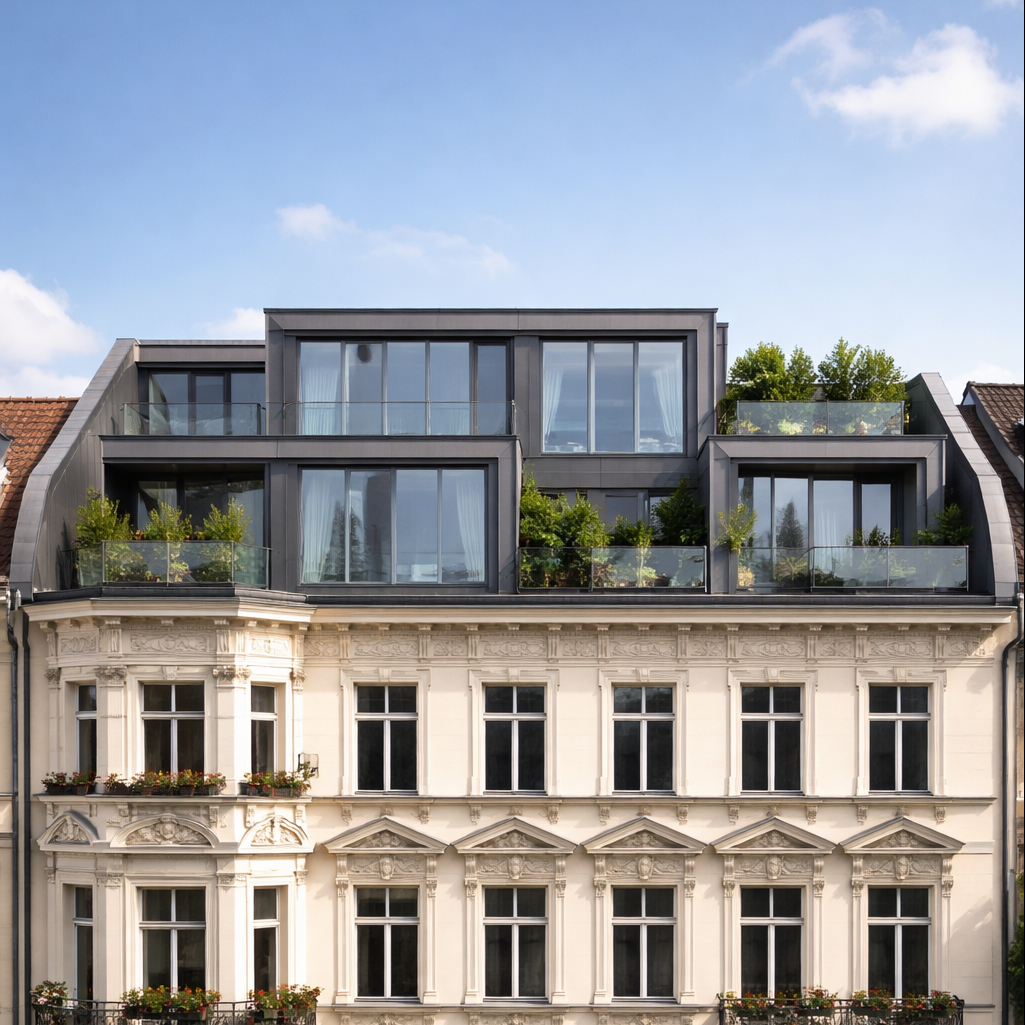
The Munich Administrative Court ruled that property owners are not entitled to a permit for energy-efficient roof renovations and new rooftop terraces if the property is located within a preservation district (a so-called “environmental protection zone”) and the planned measures exceed generally accepted residential standards. The decisive factors were that the insulation values exceeded legal requirements and the new rooftop terraces had a total area of 8.77 m² per apartment. The court viewed this as a threat to the composition of the residential population within the meaning of Section 172 of the German Building Code (BauGB).
What was the case about?
The plaintiffs sought to retrofit the attic of a building in Munich to improve its energy efficiency and construct four new rooftop terraces—two on the west side, each measuring 4.62 m², and two on the east side, each measuring 4.15 m². The property is located within the scope of the “M…/J…” Preservation Ordinance dated July 7, 2022. The building has four residential units on each floor from the first to the fourth, while the attic contains only two.
Among other things, the plan called for replacing the roof insulation with 6-cm-thick insulation boards and installing new windows with triple-pane thermal insulation glazing. The city’s Engineering Department determined that the planned insulation would achieve U-values of 0.13 W/(m²K) and 0.14 W/(m²K), respectively. This is more than 40 percent below the maximum value of 0.24 W/(m²K) required under Annex 7 of the Building Energy Act (GEG).
Why did the city deny the building permit?
The City of Munich rejected the building permit application in a decision dated September 13, 2024. It justified this on the grounds that the insulation values significantly exceeded the legally required level and thus exceeded the generally accepted residential and finishing standards in the preservation district. This, the city argued, posed a risk of displacement for the local resident population, which, according to the city, consists predominantly of lower-income households.
Prior to this, the plaintiffs had offered to waive the allocation of renovation costs to the tenants pursuant to Section 559 of the German Civil Code (BGB)—either through a contractual agreement or as a supplementary provision in the building permit. However, the city insisted on more extensive obligations in a standard contract, including disclosure requirements, a contractual penalty, and submission to immediate enforcement. No agreement was reached on these points.
How did the court rule on the energy-efficiency renovation?
The court first examined whether the plaintiffs had a binding right to the permit under § 172(4), sentence 3, no. 1a of the BauGB. This provision grants such a right if the modification serves to bring the structure into compliance with the minimum requirements of the GEG. The court ruled against this, because it was undisputed among the parties that the planned renovation falls well below the GEG minimum values and thus exceeds the statutory minimum requirements.
In the court’s view, there was also no claim under § 172(4), sentence 3, no. 1 of the BauGB (requiring the property to be brought up to modern standards). The court left open the question of whether this provision is even applicable to energy-efficiency measures. Even if one were to assume that it is, the minimum standard under building codes for energy-efficiency measures does not, in any case, exceed the GEG values—and the values in this case fell well short of those standards.
What role did the rooftop terraces play?
The court also denied the claim for approval of the planned rooftop terraces. According to the Bavarian Building Code, the installation of balconies, loggias, or rooftop terraces is not required; they are optional features. The court could not determine that apartments without rooftop terraces of the specified size do not meet today’s average standards.
From the court’s perspective, the decisive factor in the denial was the risk of displacement under Section 172(4), first sentence, of the German Building Code (BauGB). According to this provision, a permit may be denied if the composition of the resident population is to be preserved for specific urban planning reasons. Such a risk exists if a project is generally capable of triggering the displacement of the resident population due to its exemplary effect—regardless of whether specific tenants are affected in individual cases.
Why did the court see a risk of market displacement?
The court noted that, according to case law, the installation of balconies, loggias, or rooftop terraces generally results in an increase in the value of living space and, consequently, in rent increases. It also cited the 2025 Munich Rent Index: According to that index, even a balcony, loggia, or rooftop terrace measuring just 1 m² triggers a rent surcharge of 0.55 euros per square meter.
Another decisive factor was an “Information Sheet on Generally Accepted Standards for Housing and Amenities” issued by the City of Munich (as of April 2026). According to this document, rooftop terraces with an area of more than 8 m²—or, in the case of multiple terraces per apartment, a total area of more than 8 m²—no longer meet generally accepted standards. With a total of 8.77 m² per apartment, the project exceeded this threshold. The court further noted that two of the terraces faced west toward the quieter side away from the street and would have significantly improved the apartments’ natural lighting—which, taken as a whole, represented a substantial increase in value.
Did the offer to waive the rent allocation help?
No. The court clarified that, while the authority does generally have discretion to deny a permit under Section 172(4), first sentence, of the BauGB, there were no special circumstances in this case that would justify granting a permit despite the risk of displacement. The ancillary provision or contractual obligation offered by the plaintiffs to waive the apportionment of renovation costs under Section 559 of the German Civil Code (BGB) did not alter this conclusion.
In the court’s view, the cause of the risk of displacement lies not in the recoverable renovation costs, but in the permanently higher residential value resulting from the new terraces. This higher residential value cannot be offset by waiving the cost allocation. The lawsuit was therefore dismissed in its entirety; the plaintiffs shall bear the costs of the proceedings. The amount in dispute was set at 20,000 euros.
Practical Conclusions
Anyone building in a heritage preservation district should ensure that energy-efficiency renovations strictly comply with the minimum standards set forth in the GModG (formerly GEG). According to this ruling, falling significantly below the required U-values can result in the measure no longer being considered an adjustment to minimum requirements subject to approval, but rather being classified as a modernization that exceeds the minimum requirements—with the consequence that there is no longer a guaranteed right to approval.
The treatment of balconies, loggias, and rooftop terraces is particularly relevant in practice: The court confirmed that such elements are generally considered to add value and can pose a risk of displacement, even if they are quite small. Developers in areas subject to preservation ordinances should consult the relevant municipality in advance to learn about local guidelines—such as the information sheet cited in this case, which specifies an area limit of 8 m². According to this ruling, merely refraining from passing on renovation costs to the rent is not sufficient to eliminate a risk of displacement caused by structural improvements.
Source: Munich Administrative Court, Judgment of July 6, 2026, Case No.: M 8 K 24.5990
Image: Generated by AI
Jochen Mittenzwey
Attorney
Certified Specialist in Construction and Architectural Law
mittenzwey@mo45.de
